

One of the keys to completing a successful 1031 exchange is the process of locating quality replacement real estate that satisfies the exchange requirements. This task is more challenging in competitive real estate markets and in capital markets where obtaining financing is difficult. Considering the above, we often receive the following questions with respect to placing all the net equity, debt and value from the sale:
Can I use exchange funds to improve replacement property that I am acquiring in a 1031 exchange?
The principal advantage of an improvement exchange is that an investor can use “tax-deferred dollars” to improve desired property. As explained in our Article – Improvement Exchanges must be structured and executed carefully to comply with applicable statutes, regulations, and case law. The Exchanger cannot use a normal exchange agreement with a QI if they plan to make improvements to the target replacement property. It must be structured as a parking arrangement.
Parking arrangements are a key component of any improvement exchange. This is necessitated because the 1031 rules require the conveyance of complete and existing replacement real estate to satisfy the “exchange” requirement. [1] Otherwise, the regulations consider improvements yet to be constructed to be “production services” made on behalf of the exchanger. Future services are not real property and are ineligible to be paid for with exchange funds.
The parking arrangement safe harbor allows the accommodator to do the following:
1) “park” – to acquire title to the real estate under an agreement with the exchanger to prevent the exchanger from taking title;
2) improve the real estate using a construction management agreement with the exchanger or a third-party contractor; and
3) complete the exchange – sell the real estate and improvements to the exchanger at some time after the relinquished property is sold. This replacement property purchase must occur within 180-days of the date of the start of the exchange.
A STEP-BY-STEP GUIDE TO THE FORWARD IMPROVEMENT EXCHANGE PROCESS
- Planning: Contact Legal 1031 and fill out a “Parking Exchange Questionnaire.” Legal 1031 will set up a preliminary discussion. It is best to also provide us with copies of purchase and sale agreements (“PSAs”) and entity organization charts where applicable. Engage Legal 1031 when appropriate.
- ESA: If you plan to park a commercial property for improvement during an exchange, obtain a Phase I Environmental Survey (ESA) and provide it to Legal 1031 for review in advance. Legal 1031 may waive this requirement for small residential properties with an exclusive history of residential usage.
- Analysis: Discuss the transaction with your tax advisors [2]; determine the gain, debt and equity in the exchange to contemplate if your exchange plan will lead to a “balanced “exchange or partially taxable exchange. For more on replacement rules for debt and equity and balancing in an exchange, read here.
Assess Feasibility and Cost Benefit – Exchangers should also consider the practical aspects of completing a project during the 180-day exchange period. The improvements must be affixed to real estate in order to count as value for balancing purposes. Improvements cannot be prepaid along with labor and count as value if their production occurs after the exchange has been closed. They must be produced and affixed during the exchange period.
What effect will it have if the exchanger completes a partial improvement exchange and has unused cash remaining at the end of the exchange period?
Discussions with your accountant to better understand your current adjusted basis and exchange balancing are the key to formulating an exchange plan.For improvement exchanges that may only be partially complete during the exchange period, or for projects with potential improvement value under $100k, the exchanger should carefully consider the cost benefit of their plan.
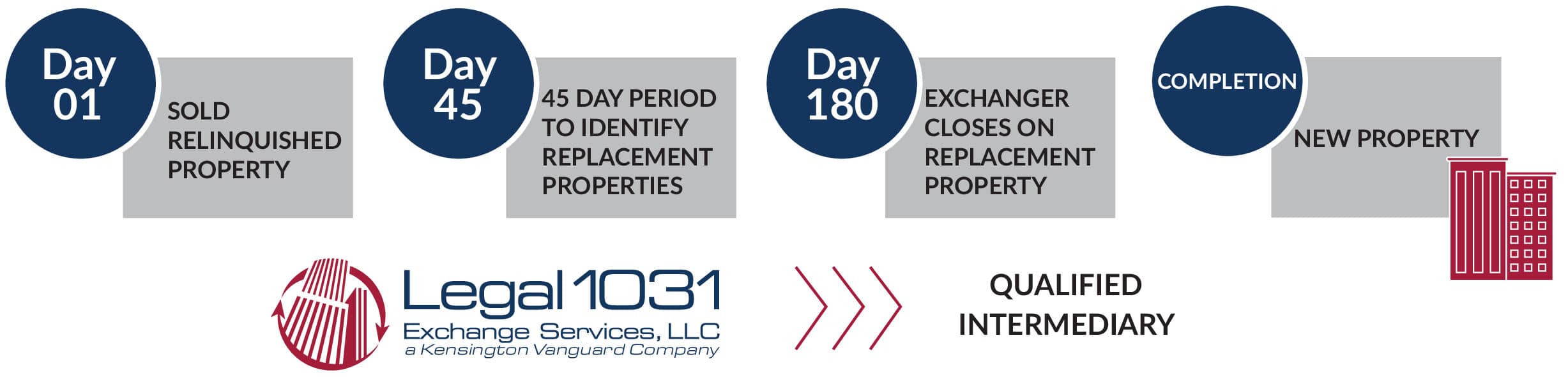
- Exchange Timelines: In a forward improvement exchange, the earliest transaction, the sale of relinquished property will control the 180-day exchange timeline and not the act of parking title with an EAT. Here is a link to a graphic illustrating the forward exchange timeline.
- For example, if the sale of relinquished property closes on January 1, 2025, starting the clock on the 180-day exchange period followed by a replacement property purchase on February 1st; the Exchanger and QI will still have 180-days from January 1st to fund and complete improvements to the property. The exchange timeline and parking timeline can run on different tracks. In this case, one being 30 days shorter than the other.
- Discuss the parking exchange structure with your Lenders (if applicable): Third-party lenders need to approve and be comfortable with Legal 1031 taking legal title to the parked property vested in EAT LLC for the duration of the exchange period. Legal 1031 can participate in preliminary calls to help a lender get a sense of the process. Once engaged, we can provide a lender with transactional documents. Take note that when parking small residential properties, obtaining loan approval from traditional bank lenders may be challenging or not feasible.
- Documentation for the Sale and Purchase: The exchanger will enter into an exchange agreement with Legal 1031 Exchange Services, LLC as a Qualified Intermediary (QI) to sell the Relinquished Property and when appropriate enter into a Qualified Exchange Accommodation Agreement (QEAA) with the Exchange Accommodation Titleholder (“EAT”), Legal 1031 EAT Holdings, LLC, to park Replacement Property.
- Relinquished Property Sale: Exchanger will “sell” transfer title to the relinquished property using the QI, and Legal 1031 will receive and hold the sale proceeds in exchange escrow.
- Exchanger will assign its position/rights to purchase the parked property from EAT LLC to QI through our exchange documents.
- Purchase Phase: The forward exchange escrow is used to acquire replacement property for the EAT, vested in EAT LLC. Escrow may subsequently be used to fund some or all the improvements to the replacement property while it is parked with the EAT.
- Formation of the EAT LLC / titleholder LLC: Either Legal 1031 or the Exchanger’s attorney will help form the new titleholder LLC (“the LLC” or “titleholder LLC”) in the state where the parked property is located. Legal 1031 EAT Holdings, LLC, will be the sole member of the LLC for the duration of the exchange and it will not obtain a separate Federal EIN/TIN. The Exchanger may name the LLC subject to state rules. EAT LLC is disregarded for tax purposes and typically does not have income while it is owned by the EAT
- Assignment: Purchase documents should reflect the new titleholder LLC as the buyer. Depending on the Exchanger’s progress in the acquisition timeline, purchase agreements may need to be assigned, amended or a novation prepared to achieve a legal substitution of the purchaser. Additionally, documents prepared in advance like insurance (title, property, and general liability), leases, transfer and loan documents may require revisions to reflect the LLC as the buyer/borrower.
- Documents: Legal 1031 will prepare documents needed to park the replacement property, a Qualified Exchange Accommodation Agreement (“QEAA”) and ancillary documents for the Exchanger to review with their advisors and execute.
- Obtain insurance policies: Certificates of Insurance (COIs) or other proof of coverage insuring for general liability and construction projects must be provided to Legal 1031 for review prior to closing. The applicable policies must insure the LLC, name Legal 1031 EAT Holdings, LLC as an additional insured, and meet the required coverage limits. To avoid delays, we recommend initiating the insurance process as early as possible. Please contact us for additional details regarding our insurance requirements.
For construction-related coverage, contractors working on the project or a general contractor may be able to include the appropriate parties under their existing site-specific policies.
- Review financing documents: If a third-party lender is involved, Legal 1031 needs reasonable time to review loan documents to ensure that they are compliant with the parking exchange structure. All loan documents must include nonrecourse language with respect to Legal 1031 entities and personnel (Legal 1031 will provide).
- Pre-Closing review and coordination: Exchanger’s Counsel and Legal 1031 will coordinate with closing agents and other parties to ensure that the closing statement, closing documents, and loan documents are properly formatted.
- “Parking” the Replacement Property / Closing on Your Purchase: The EAT, through a wholly owned disregarded subsidiary the titleholder LLC/LLC, will acquire title to the replacement property. The acquisition will be funded using exchange proceeds held by QI, together with any additional funds contributed by the Exchanger or provided by a third-party lender (e.g., a bank).
Title to the replacement property is vested in the newly formed titleholder LLC (effectively “parking” the property’s title); the Exchanger now has 180 calendar days to sell relinquished property in order to complete the exchange. The LLC provides a promissory note to the Exchanger for cash funds borrowed to acquire the replacement property and later pays it back.
- Improvement Phase: Exchanger may begin to coordinate funding improvements through QI by entering the LLC into construction contracts or assigning said contracts to the LLC. Invoices for construction draws may be submitted along with authorization forms. Wires are strongly preferred over checks. Checks are slower and will incur additional costs to process.
- Submit a Written Identification Statement by the 45th day from the Relinquished Property Sale: Legal 1031 will provide an Identification Form and schedule for identifying improvements with its QI documents.
- Funds held in escrow by the QI may be utilized to improve the parked property through an arrangement where the funds are advanced to the titleholder LLC by the QI and used to pay contractors by a Construction Management Agreement between the Exchanger and the EAT.
- Exchange: Once the improvements are completed, QI will use proceeds from the sale of the relinquished property to advance payments to EAT for its interest in title or more likely, interest in Titleholder (which holds all of the replacement property, consisting of title to the already existing property or the land and to the newly constructed improvements to suit the exchanger’s requirements). Exchange proceeds can also be used to pay down any excess debt from a third-party lender secured to the parked property. This is typically done to “balance the exchange.”
- Transfer of Parked Property (LLC): Typically, transfer of the parked property to the Exchanger is achieved by assigning them 100% of the ownership interests in LLC, which qualifies as title for 1031 exchange purposes. In the alternative, the actual title to the parked property can be conveyed. [3] Either way, transfer must happen prior to the end of the Exchange Period – the 180th day in order to complete a timely exchange.
- LLC Note Payoff: If the exchanger has contributed money out of pocket to fund the improvements or acquisition or Replacement Property, for exchange purposes, these funds are considered a loan to LLC. Once the exchange is closed, the LLC will pay off the note to the Exchanger using any remaining funds in the exchange escrow.
- Completion: The Improvement Exchange is complete with respect to the parked property and any affixed/completed improvements. If there are excess exchange proceeds, the Exchanger may continue to acquire additional replacement properties via a forward exchange.
- Documentary Considerations and Best Practices: Exchanger and QI should keep a file of all payment records for improvements. Exchanger should consider obtaining engineer reports or appraisals and contractor certifications to substantiate the improvement value. Such documents can also substantiate that the improvements were intact at the time the LLC or title was transferred to the Exchanger.
- Post Exchange Action Items and Tax Reporting: As appropriate, Exchanger should ensure that the LLC records have been updated to reflect a transfer. The forward-moving improvement exchange commences on the date of sale, like any forward exchange, and it ends on the day the LLC or title is transferred with new improvements. You should consider this when completing the IRS Form 8824 with your accountant. The purchase is on the date the replacement property is transferred and considers the value paid for improvements.
For general information see our article linked here: Post Exchange Action Items and Considerations
CONCLUSION
An Improvement exchange can provide an avenue for an investor to acquire an ideal development site and effect a custom build. Although this exchange structure can require advanced planning, it can potentially take some of the risk out of attempting to locate multiple replacement properties in a short period of time.
[1] See Treasury Regulations §1.1031(k)-1(e)(3) – (5).
[2] As an intermediary, Legal 1031 is prohibited from acting as a tax or legal advisor. However, we can provide information and be a resource for your team of advisors. Under no circumstances do we provide accounting or tax advisory services for exchange clients.
[3] Conveying actual title can be a convenient or efficient method of transfer in some parking exchange situations, including all cash exchanges where there are multiple taxpayers involved. Exchanger should coordinate with their title insurer with respect to the vesting – ultimate ownership of the property.
Legal 1031 Exchange Services LLC and Legal 1031 EAT Holdings, LLC do not provide tax or legal advice, nor can we make any representations or warranties regarding the tax consequences of any transaction. Taxpayers must consult their tax and/or legal advisors for this information. Unless otherwise expressly indicated, any perceived federal tax advice contained in this article/communication, including attachments and enclosures, is not intended, or written to be used, and may not be used, for the purpose of (i) avoiding tax-related penalties under the Internal Revenue Code, or (ii) promoting, marketing, or recommending to another party any tax-related matters addressed herein. Information in this article and linked herein may not constitute the most up-to-date legal or other information. We recommend that taxpayers and their advisors independently analyze the benefits and risks of their 1031 exchange and those related tax strategies.
Restrictions on Use: Articles or content in any medium including content on Legal1031.com is provided by our Team to clients, readers, users, only for limited purposes. Accordingly, you may not upload content from Legal 1031 into any; bot, chatbot, or external application, including in connection with artificial intelligence technologies, such as large language models, generative AI, or training a machine learning or AI system.
Rev 4.6.26 © 2026 Legal 1031 Exchange Services LLC. All rights reserved. No rights claimed with respect to public domain and fair use materials contained or linked in this article.